
We would rather you understand the decision than just sign a proposal. These are the questions Phoenix-area homeowners and building owners actually search for, with the honest answers. If yours is not here, call 308-289-0537.
01 / 6 questions
Cost
Q.01How much does spray foam insulation cost?
There is no honest single number. Price depends on the square footage being sprayed, open-cell versus closed-cell, the thickness required, how accessible the area is, and whether old insulation has to come out first. Closed-cell costs more per inch than open-cell because it is denser and uses more material. That is why we do a free on-site assessment and then give you a written proposal with a firm price for the defined scope.
Q.02How much does it cost to spray foam a 2,000 square foot house or attic?
The footprint of the house is only the starting point. Insulating the underside of a roof deck covers more area than the attic floor because of the roof pitch, and gable walls and knee walls add more. Two homes of the same size can price quite differently. We measure the real surfaces during the assessment so the number in your proposal reflects your house, not an average.
Q.03What about a garage?
Garages are a popular spray foam project in the Valley, especially when they double as a workshop, gym or storage for things that do not like heat. Cost depends on whether we are doing walls, the ceiling or roof deck, the garage door area, and which foam is right. Detached garages and metal buildings often call for closed-cell.
Q.04Is it cheaper to spray foam or install regular insulation?
Up front, blown-in and batt insulation cost less than spray foam. Spray foam costs more because it insulates and air seals in one step and can be applied where loose-fill cannot, such as under a roof deck. For some homes the extra cost earns its keep; for others, air sealing plus blown-in insulation is the better value. We will tell you which we think fits your building.
Q.05How much does insulation removal cost?
Removal is priced mainly on the attic area, the depth and type of the old material, how easy the attic is to access and whether contamination such as rodent waste requires extra care. It is usually quoted together with the new insulation that goes back in. See insulation removal.
Q.06What time of year is insulation work cheapest?
We do not run seasonal pricing games. What does change with the season is comfort: attic work is easier to schedule in the cooler months, and getting it done before summer means you get the benefit through the hottest stretch. Some utilities in Arizona have offered rebates on insulation and air sealing at times; check with APS or SRP for what is available when you are planning.
02 / 5 questions
Is spray foam right for me?
Q.07What are the downsides of spray foam insulation?
Fair question. It costs more than traditional insulation. It has to be installed correctly, at the right temperature, thickness and mix, which makes the installer as important as the product. Occupants need to stay out during application and for a ventilation period afterward while it cures. Once applied, it is difficult to remove, and covering the underside of a roof deck means a roof leak can be harder to spot from inside the attic. None of these is a reason to avoid foam, but they are reasons to choose your contractor carefully and to use foam where it actually earns its cost.
Q.08Why do some people say spray foam makes a house harder to sell?
When foam covers the underside of a roof deck, some home inspectors cannot see the roof framing and sheathing, and some buyers and lenders are less familiar with conditioned attics. Good documentation helps: keep the proposal, product information and warranty paperwork with your home records, and a properly installed foam job becomes a selling point for comfort and efficiency instead of a question mark.
Q.09Why are people removing spray foam?
In most cases it is because of a poor installation: foam that was mixed or applied incorrectly, applied too thick in one pass, or put in the wrong place. Problem jobs get attention online, which is why it pays to work with a contractor who explains what they are installing and why.
Q.10Why shouldn't you spray foam your attic?
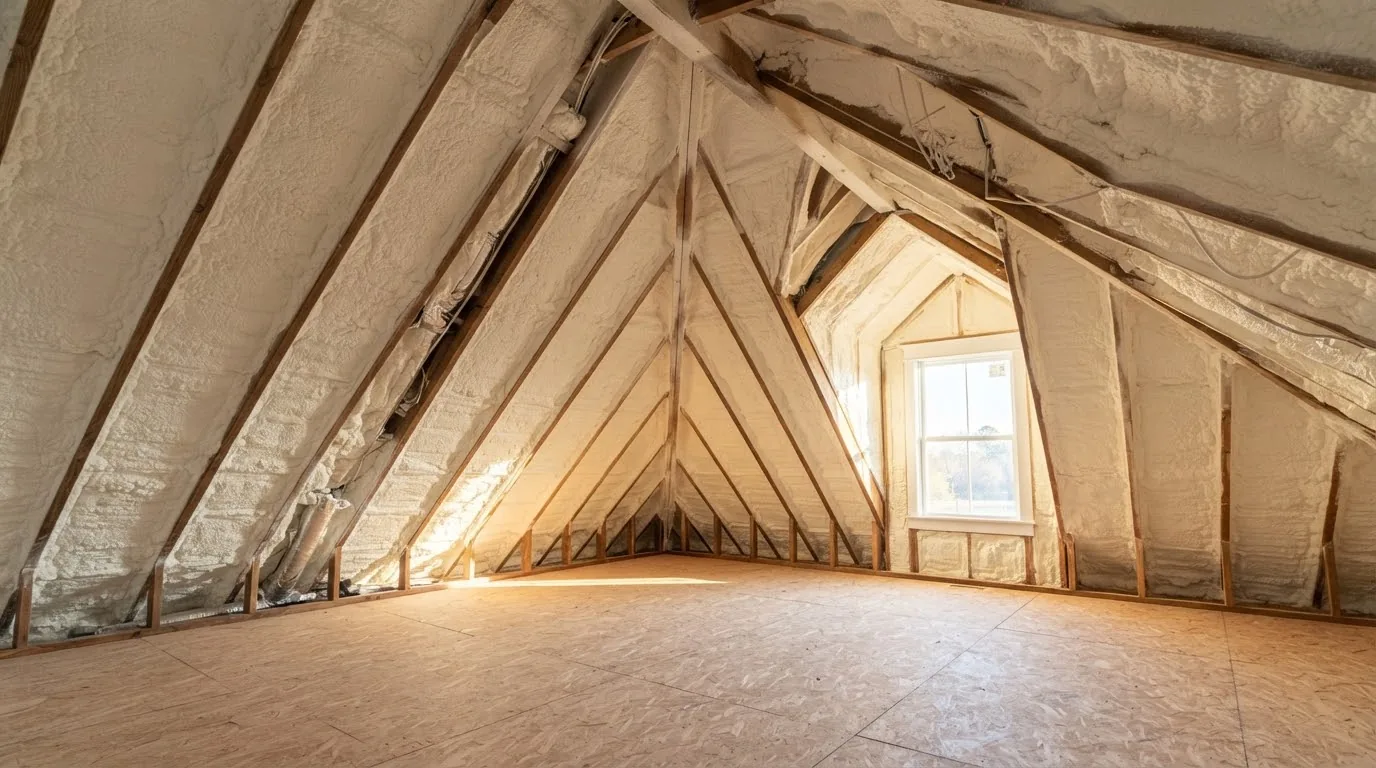
Sometimes you should not. If the attic is well vented, the ductwork is in good shape and the main issue is simply not enough insulation, adding blown-in insulation on the attic floor with good air sealing can be the smarter spend. Spray foam on the roof deck makes the most sense when ducts and equipment are in the attic, when there are many air leaks that are hard to seal, or when the attic space itself needs to be usable.
Q.11What is better than spray foam insulation?
There is no single best product, only the best fit for a space. Closed-cell foam has the highest R-value per inch of the products we install. Blown-in insulation is the most economical way to add depth to an open attic floor. Batts are simple and affordable in open walls. We pick by the building, not by habit.
03 / 6 questions
Arizona attics
Q.12What is the best attic insulation for Arizona?
For homes with ductwork in the attic, insulating the roof deck with open-cell spray foam is often the most effective upgrade because it keeps the attic, and the ducts, out of the extreme heat. For vented attics without ducts, or where budget is the priority, air sealing plus blown-in insulation on the attic floor works well.
Q.13What R-value should an Arizona attic have?
The Phoenix area falls in a hot climate zone where U.S. Department of Energy and ENERGY STAR guidance generally points to roughly R-30 to R-60 for attic floors, depending on what is already there. Spray foam on a roof deck is evaluated differently because it also stops air movement. Local building code minimums apply to new construction. We will measure what you have and recommend a target that makes sense for your home.
Q.14Can you put too much insulation in an attic?
Past a certain depth, each extra inch returns less and less, so piling on more than recommended is mostly wasted money. Insulation should also never block soffit vents in a vented attic or be packed against equipment that needs clearance. Getting the depth right matters more than getting it as deep as possible.
Q.15What are the signs of bad attic insulation?
Rooms that heat up fast in the afternoon, a second floor that is much warmer than the first, an AC that runs almost nonstop, ceilings that feel warm to the touch, and dusty air near light fixtures and vents. In the attic itself: insulation that is thin, flattened, patchy, stained or disturbed, or that shows droppings and nesting.
Q.16What is the lifespan of blown-in insulation?
Loose-fill insulation can last for decades if it stays dry and undisturbed. In practice it settles, gets compressed by people working in the attic, and can be damaged by roof leaks or pests. When it loses depth or gets contaminated, it stops doing its job long before it wears out.
Q.17Can I put plywood on top of blown-in insulation for storage?
Laying boards directly on loose-fill compresses it and cuts its effectiveness. If you need attic storage, the better approach is a raised platform built above the insulation depth, so the insulation underneath keeps its full thickness.
04 / 4 questions
Removal and pests
Q.18Should you remove old attic insulation before adding new?
Not always. If the existing insulation is dry, clean and simply too thin, new insulation can usually go on top. It should come out if it is contaminated by rodents, wet or stained from roof leaks, smoke-damaged, moldy, or if we are spraying foam on the attic floor or need clear access to air seal properly.
Q.19Is it worth removing old insulation?
When the old material is contaminated or failing, yes. Removal lets us air seal the ceiling plane properly, gets rid of odors and droppings, and gives new insulation a clean base. Read more about insulation removal.
Q.20What is the best way to remove old insulation?
For loose-fill, a high-powered insulation vacuum that pulls material through a hose into bags or a collection unit outside the house, so it never travels through your living space. Batts are bagged by hand. Either way, the work area is protected and cleaned when we finish.
Q.21Do mice like blown-in insulation?
Rodents nest in soft, loose insulation because it is warm and easy to tunnel through, and they can do the same in many insulation types. The real fix is sealing the entry points, removing contaminated material and then re-insulating. If you have seen signs of rodents in the attic, mention it when you book the assessment.
05 / 4 questions
Working with us
Q.22Do you offer free estimates?
Yes. Every project starts with a free consultation and on-site assessment, followed by a detailed written proposal.
Q.23Do you warranty your work?
Yes. Completed projects come with a warranty on the work. The proposal explains what it includes.
Q.24What areas do you serve?
The Phoenix metro, including Phoenix, Mesa, Scottsdale, Gilbert, Chandler, Tempe, Glendale, Peoria, Cave Creek, Queen Creek and San Tan Valley. We also work in Nebraska and travel for projects nationwide. See service areas.
Q.25What are your hours?
Monday to Friday, 8:00 am to 5:00 pm. Closed Saturday and Sunday. Call 308-289-0537.
Free quote
Still have a question?
Call during business hours or send your project details. We will answer honestly, even if the answer is that you do not need foam.
- Free consultation and assessment
- Detailed written proposal
- Install scheduled around you
- Warranty on completed work
- Immaculate clean-up
Mon–Fri · 8:00–5:00